Panoramic Photo Above:
1929 Pennant Winning Chicago Cubs
Baseball History Comes Alive Now Ranked As a Top Five Website by Feedspot Among All Baseball History Websites and Blogs!
(Check out Feedspot's list of the Top 35 Baseball History websites and blogs)
Countdown to Opening Day, 2027
Guest submissions from our readers always welcome click for details
Visit the Baseball History Comes Alive Home Page
Subscribe to Baseball History Comes Alive
Free Bonus for Subscribing:
Gary’s Handy Dandy World Series Reference Guide
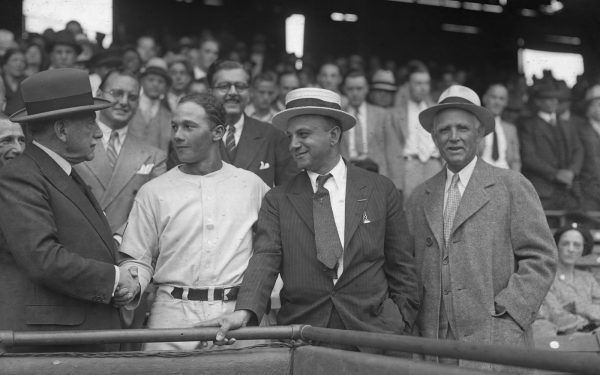
If there is one group whose contributions to the game are often overlooked, it’s baseball scouts. Today, we welcome Vince Jankoski with an interesting essay about the career of Latin American scout, Joe Cambria. I had heard of him over the years but was unaware of just how great his pioneering scouting was in Latin America. To say that he opened the door to Latino – most notably Cuban – players is not an exaggeration. And so today, we’re happy to shine our baseball spotlight on him. In the featured photo above, we see Joe Cambria (center) with Cuban player Bobby Estalella, and Washington Senators owner Clark Griffith on right. –GL
Let’s Salute Pioneering Baseball Scout, Joe Cambria
Sometimes it takes a while to discover where you truly belong. The Sicilian-born Joseph Carl Cambria (nee Carlo Cambria) emigrated to Boston in the 1890s. He played professional baseball in Rhode Island and in Ontario, Canada. After service in the American army in World War I, he relocated to Baltimore, where he ran a laundry business.
But it was baseball, not laundry, that was his true passion. In the 1920s and 1930s, he owned minor league clubs in Maryland, West Virginia, Ohio, New York, Pennsylvania, Massachusetts, Florida, South Carolina, and Tennessee, usually for only a year or two at a time. He was also co-owner of the Baltimore Black Sox, a Negro League team.
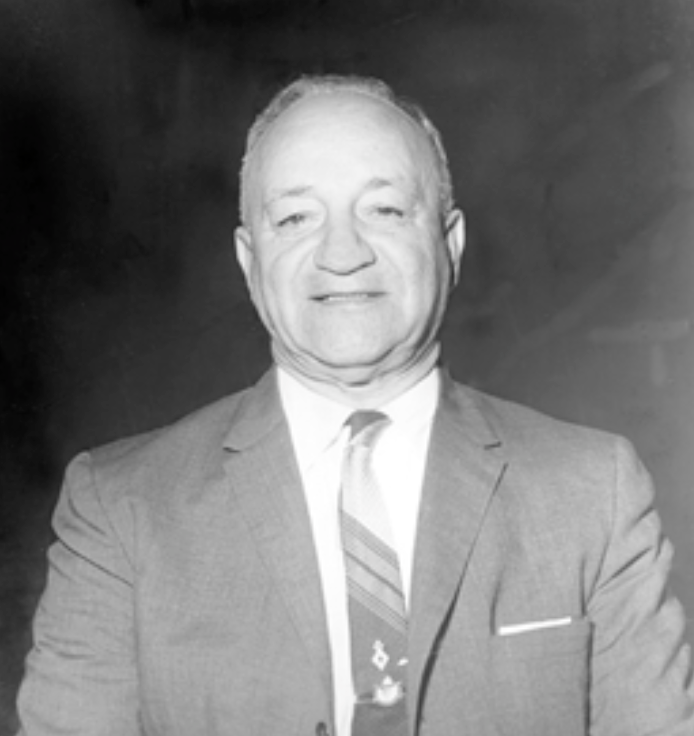
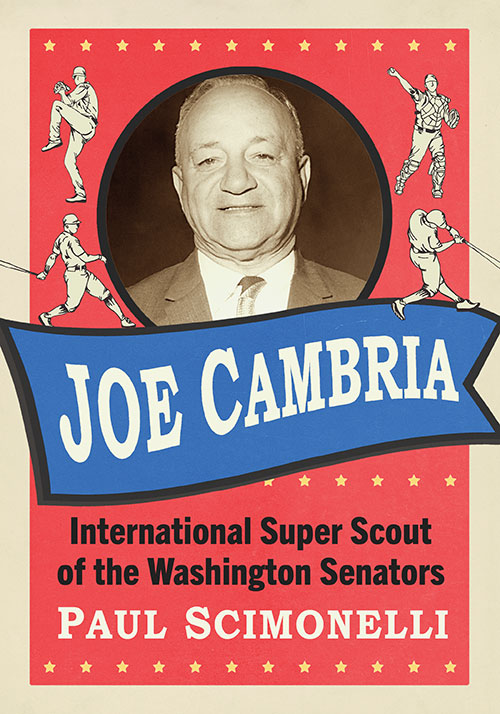
It was while owning the Albany Senators of the International League that Papa Joe Cambria first collaborated with Washington Senators owner Clark Griffith. It was a match made in baseball heaven. Cambria’s skill set included recognizing young talent that could be signed for a pittance and sold to major league teams for a profit. It was the way in which minor league clubs stayed afloat during the Depression. Griffith was the owner of a team in one of the smallest cities in the major leagues. Revenue, generated mostly by ticket and concession sales at the time, was limited. Plus, the Washington Senators were the family business, not a hobby as many clubs are today. Unlike today’s game, where the money is made on the capital appreciation when the team is sold, owners back in Griffith’s day, Griffith included, needed to turn a yearly profit lest the breadlines beckon. That meant keeping costs down, including player salaries and signing bonuses.
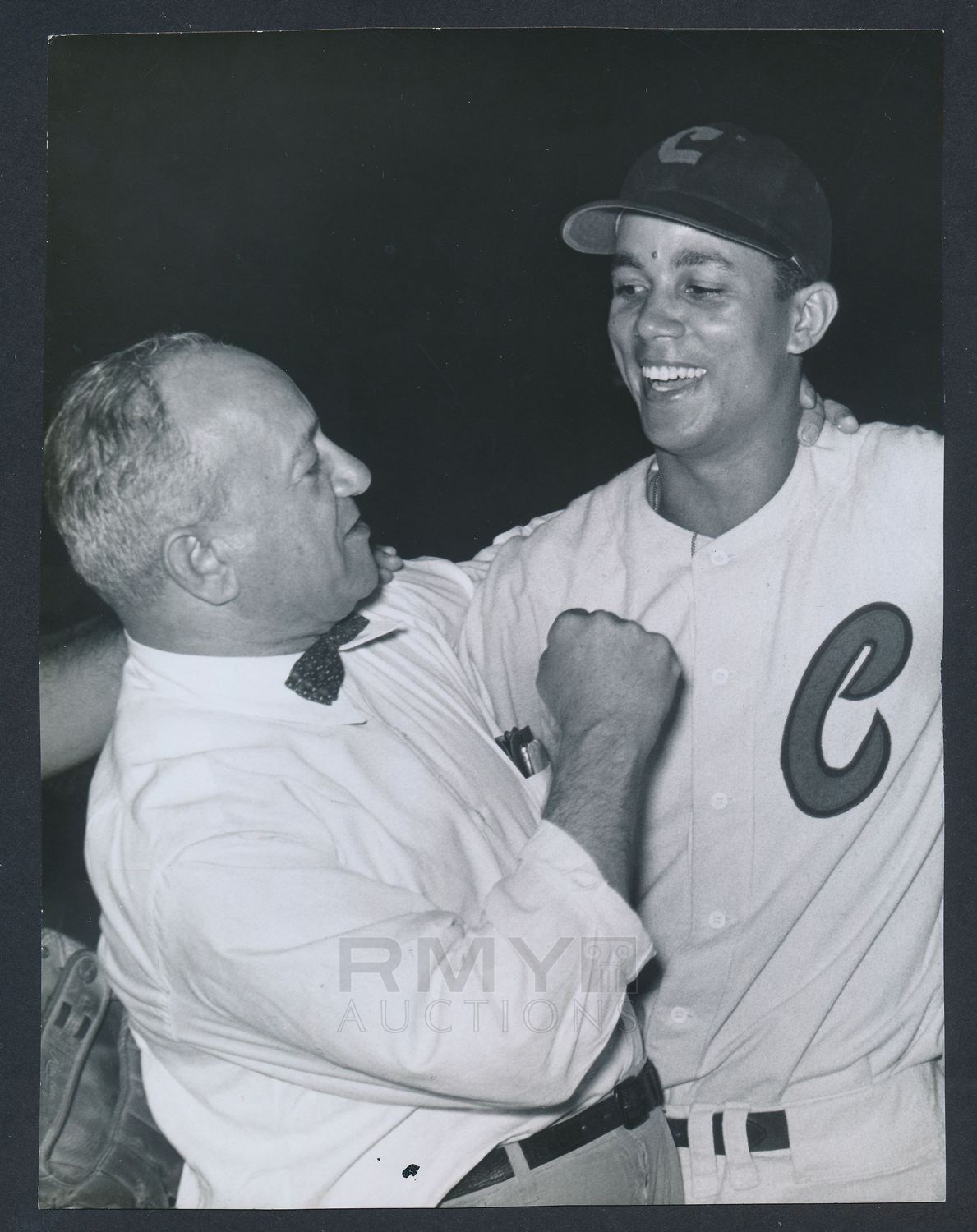
Cambria began signing young players and selling their contracts to Griffith. Most notably, there was Mickey Vernon (2,495 career hits, two-time American League batting champion, seven-time All-Star) and George Case (six-time American League stolen base leader, three-time All-Star). Cambria sold players to other teams as well, but his predominant buyer was Griffith.
In the 1930s, Cambria discovered Havana. Winters were milder than in Baltimore, the nightlife was good, and there was abundant talent to scout and sign. By 1940, Havana was more or less Cambria’s permanent base of operations. He could enjoy the mild weather, sip drinks at Havana’s finest watering holes, watch baseball, and earn a good living at the same time. He must have felt like he died and gone to heaven. Never mind that he left his invalid wife back in Baltimore. Cambria developed a system of “bird dog” scouts who traveled to remote parts of the island to view talent. So, Cambria never even had to leave the pleasures of pre-revolution Havana.
Griffith was on board with this. He recognized that Cubans played an excellent brand of baseball, and that Latin American talent was inclined to work for less money than Americans. Sound familiar.
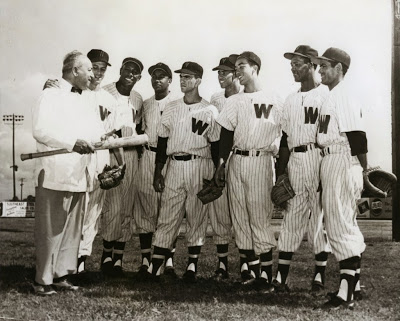
Cambria was not the first person to scout and sign Cuban players, but he was the most prolific. He is reputed to have signed nearly 400 Cubans to professional contracts, mostly for the Senators. He also spread his reach to ink contracts for players from other Latin American countries. Scores of his Latin signees reached the highest level of the sport, including Tony Oliva, Camilo Pascual, Pedro Ramos, and Zoilo Versailles. Versailles and Oliva would finish first and second in the American League MVP balloting in 1965, the year the transplanted Senators won the pennant in Minnesota. Pascual and Ramos were mainstays of the Senators’ pitching staffs in the late 1950s and early 1960s.
There was even a tall right-handed pitcher with a fine curveball whose heater simply did not meet major league standards. Notwithstanding that Cambria passed on the young hurler, they remained friends even after the youngster seized power on the island. Another version of the story asserts that his fastball was lively, but his control was lacking. Some claim that the hurler was a southpaw, notwithstanding images of the dictator in pitching motion clearly show the ball embedded firmly in his right hand. Regardless of whether Fidel Castro was ever a serious major league prospect, the Cuban leader loved the game. He and Cambria became friends, and Cambria was permitted to remain on the island until his terminal illness in 1962. However, Castro turned off the spigot that was the transfer of talent from Cuba to the United States.
There is no doubt that Cambria was one of the greatest scouts of all time. He is criticized for two things (leaving aside the abandonment of his invalid wife back in Baltimore): his stripping Cuba of its best baseball talent and his purported racism in favoring light-skinned Cuban players.
As to the former, most Cubans were proud to produce talent recognized by major league teams. For the most part, they did not resent their best players moving to the United States. The players who came to the United States, although often paid less than their American counterparts, were still compensated at rates much higher than they would have received in Cuba. It was a good deal for them. Then, too, the American Negro leagues were scarfing up Cuban talent before Cambria got to the island. After all of the “poaching”, there was still enough talent left in Cuba to produce an entertaining brand of baseball.
As to the charge of racism, consider where Cambria was directing talent. Washington in the 1930s, 1940s and 1950s was a segregated town. Indeed, baseball itself was segregated until 1947. Papa Joe cannot be blamed for sending black talent to a place where there were no openings. Even so, Cambria signed the first player of African descent to play for the Senators, Carlos Paula. N.B. Paula was not the first African-American to play for the Senators, as Paula was Cuban. Joe Black of Dodger renown has the distinction of being the first African-American to play for Washington’s American League team – the answer to a good trivia question. Paula first took the field in Griffith Stadium on September 6, 1954, eight years before black players suited up for Washington’s NFL team. Oliva, Versailles, Julio Becquer, and Jose Valdivielso soon followed Paula.
The much-traveled Joe Cambria found his niche in Havana. While he did not open the island to the major leagues, he surely demonstrated that there was a wealth of Cuban talent which, once again, has begun to permeate the game. The baseball world is better for it. Like his benefactor Castro, Papa Joe Cambria was, in his own way, a revolutionary.
Vince Jankowski
Photo Credits: All found on Google search
Subscribe to Baseball History Comes Alive. FREE BONUS for subscribing: Gary’s Handy Dandy World Series Reference Guide. https://wp.me/P7a04E-2he
Visit the Baseball History Comes Alive Home Page