
Baseball History Comes Alive Now Ranked As a Top Five Website by Feedspot Among All Baseball History Websites and Blogs!
(Check out Feedspot's list of the Top 35 Baseball History websites and blogs)
Guest Submissions From Our Readers Always Welcome! Click for details
Visit the Baseball History Comes Alive Home Page
Subscribe to Baseball History Comes Alive
Free Bonus for Subscribing:
Gary’s Handy Dandy World Series Reference Guide
Wow! File this one into the file marked “Lost Potential.” I had heard of Louis Sockalexis but knew nothing about him. Rod Christensen fills in that gap today with an interesting essay about the first Native American ball player who had the potential to be one of the greatest players ever, as the opening quotes below attest. His story is a real eye-opener! -GL
Louis Sockalexis:
“Deerfoot of the Diamond!”
“He could have been better than Cobb, Wagner, or Ruth!” –John McGraw
“He should have been the greatest player of all time!” -Hughie Jennings
“Sockalexis was the greatest outfielder in history, the best hitter, the best thrower, the best fielder, and also the best drinker!” -Ed Barrow
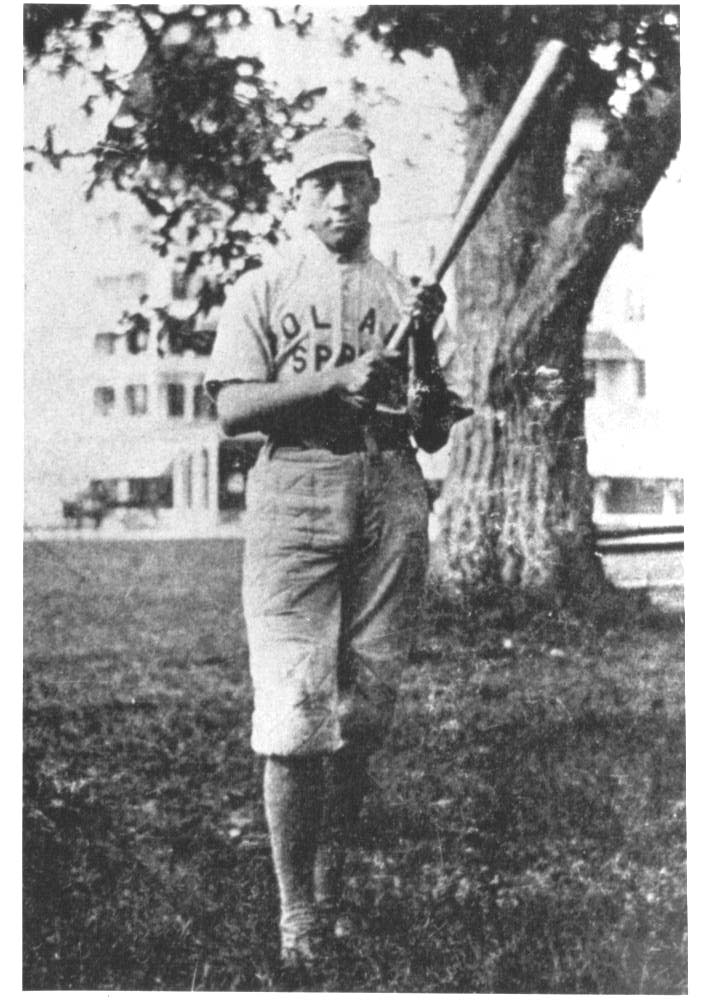
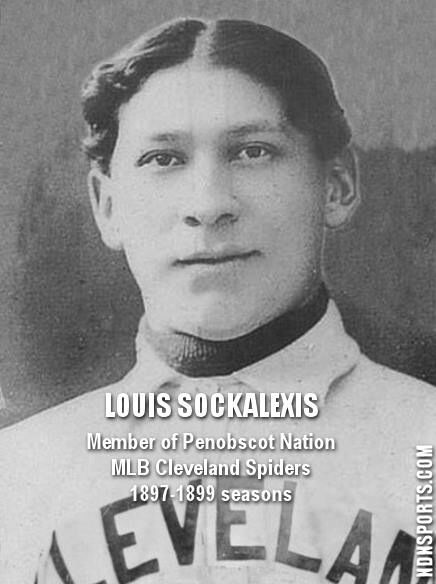
Lou Sockalexis was the first person of Native American ancestry to play major league baseball. His career spanned only three years, from 1897 to 1899, and from his all too brief time in baseball, there has evolved a tightly woven tapestry of fact and romanticized fiction that is today the stuff of legend. A trailblazer much like Jackie Robinson fifty years later, Sockalexis arrived with immeasurable talent and unlimited potential, and proved himself an immediate success. Also like Robinson, Sockalexis endured a torrent of verbal abuse, derisive comments, racial slurs, and threats from fans, opposing players, and the public at large. Newspapers referred to him as a Savage. But unlike Robinson, Sockalexis was a tragic figure, a shooting star whose demons inexorably led him to the throes of self-destruction, the loss of his career, and ultimately, his own demise.
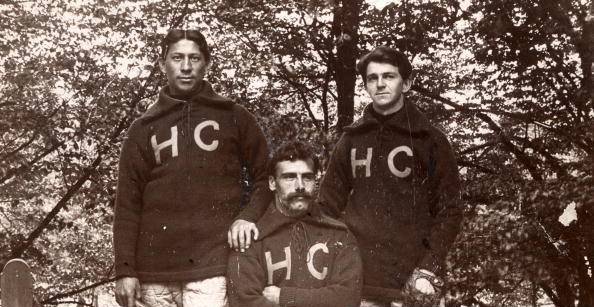
A Penobscot Indian whose grandfather was a tribal chief, Sockalexis was born October 24, 1871, on the Penobscot Reservation near Old Town, Maine. Possessed of a cannon arm and blazing foot speed, it was said that Sockalexis could throw a baseball across the width of the Penobscot River and hit a baseball 600’. In the summer of 1894, some of the players from the Holy Cross baseball team, including Mike “Doc” Powers, who would later play with the Philadelphia Athletics, traveled north to Maine to play in a summer league in which Sockalexis competed. Impressed with his skillset, Sockalexis was recruited to play at Holy Cross the following year, where, in addition to baseball, he also ran track and played on the college’s inaugural football team.
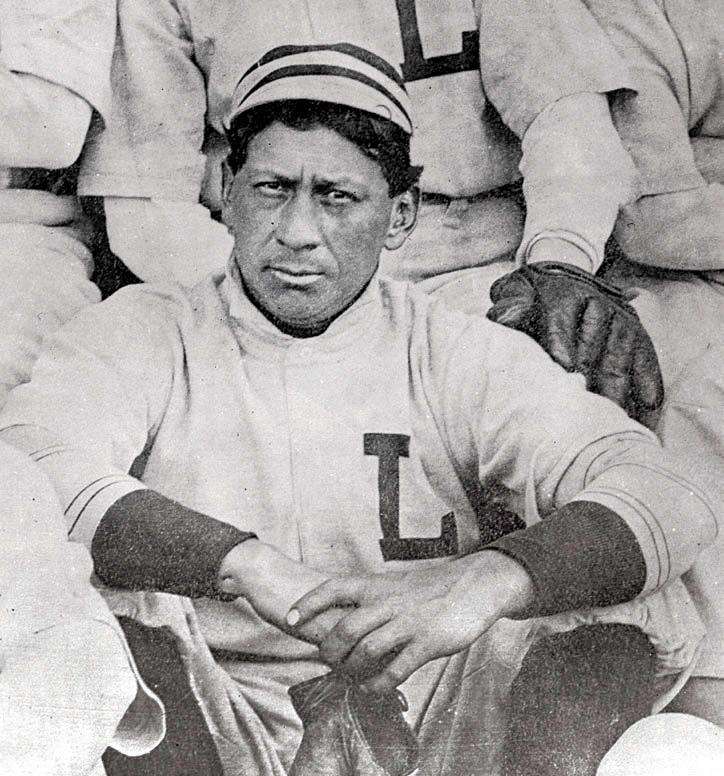
Sockalexis remained at Holy Cross for two years, and in his two seasons playing baseball, the team went 36-12 and Sockalexis batted .436 and .444, respectively. Here again the demarcation between fact and fiction becomes grayed and somewhat blurred. In a game against Brown University, it is said that Sockalexis stole six bases and went 4-for-5 at the plate, including a home run that cleared the outfield fence and broke a fourth-story window in the university’s chapel. In another game against Williams College, Sockalexis is said to have hit a ball over the center fielder’s head and scored standing up before the fielder even reached the ball. And in yet another game against Harvard, a Crimson batter hit a ball over Sockalexis’s head that rolled past some trees and onto a tennis court beyond (the field had no fence). Sockalexis is said to have chased down the ball and, with his cannon arm, made a frozen-rope throw to the pitcher, holding the batter to a triple. Impressed by this Herculean throw (as were all in attendance), two Harvard professors later measured the distance of the throw at 414 feet.
Future Hall of Famer Jesse Burkett, then an outfielder with the Cleveland Spiders of the National League, hailed from Worcester and knew of Sockalexis’s abilities from his time at Holy Cross. Burkett arranged a tryout for Sockalexis with the Spiders, who immediately signed him to a contract for the 1897 season. Sockalexis proved an immediate success with Cleveland. He is reported to have hit home runs in his first two Spider at-bats, though this is disputed and is more likely part of the myth-building that so surrounds him. Nonetheless, Sockalexis was a standout on a team that boasted three future Hall of Famers: Cy Young, Bobby Wallace, and Jesse Burkett.
For the first few months of the season, Sockalexis garnered newspaper headlines on an almost daily basis, as much for his Indian heritage as for his spectacular play on the field. He singlehandedly resurrected fan interest in a dying Cleveland franchise by becoming a gate attraction for fans and press alike, curious to see a Native American play baseball.
By July 3rd, Sockalexis was batting .328 with 39 RBI’s, 40 runs scored, and 16 stolen bases. ‘The Sporting Life’ reported that he had been a factor in just about every victory won by the Spiders so far that season. And then the bottom fell out as his demons resurfaced. July 4, Independence Day, was a Sunday in 1897, and no game was scheduled. Sockalexis and several teammates celebrated the off-day holiday drinking and cavorting in a red-light district in Cleveland, where sometime in the early morning hours, Sockalexis either jumped or was pushed from a second-floor window, severely spraining his ankle when landing on the street below. The injury forced him out of the lineup and likely served as a catalyst for his continued drinking while away from the team. When he did return, his play was greatly diminished from what fans and teammates had come to expect of him, more often than not because he was inebriated or hungover.
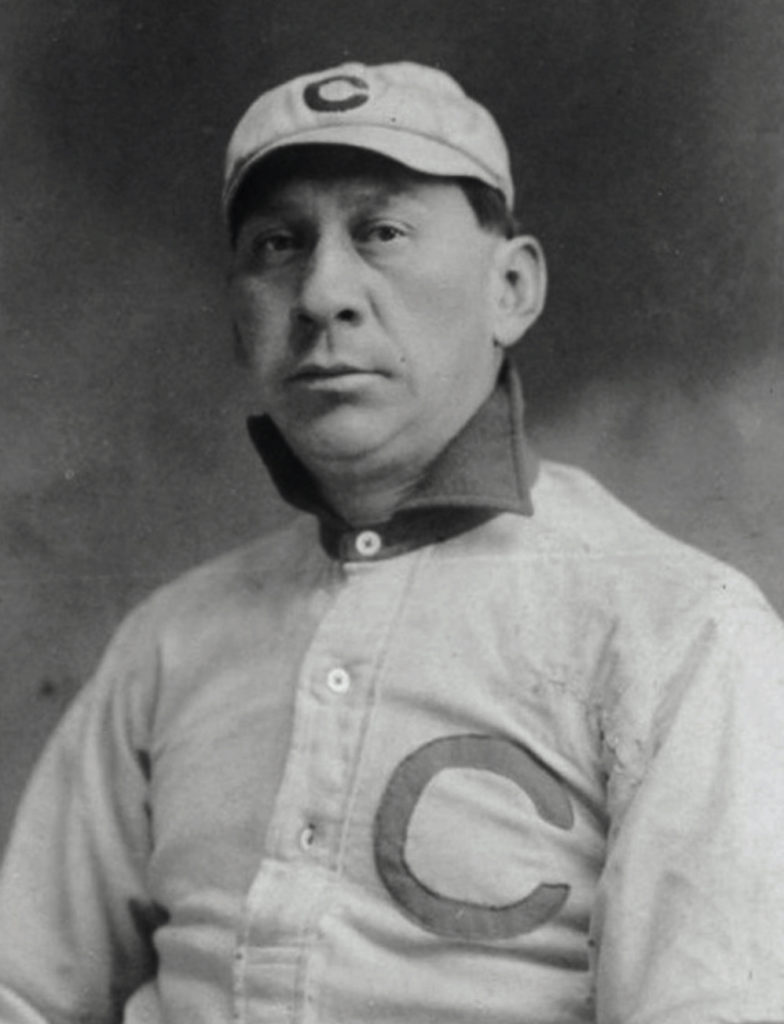
Sockalexis played in only eight more games that season, and though his ankle injury eventually healed, his alcohol addiction worsened. In 1898, he played in only 21 games and batted only .224, the drop-off in performance being the direct result of drunkenness. In 1899, Sockalexis reported to camp but was in no condition to play. His once athletic, muscular frame had ballooned to well over 200 pounds. Catcher Charles ‘Chief’ Zimmer, then 38 years old, said, “I could give him twenty yards and beat him in a hundred . . . you wouldn’t know the big Indian if you saw him now.” He still had his moments, however. In a game on May 11, he went 5-for-5 with four doubles and made a throw from right field that cut down a runner at third. Two days later, he fell down twice in the outfield fielding routine ground balls, a result of inebriation. A few days later, he was arrested in a drunken dispute in a Cleveland theater. The following day, the Spiders released him, ending his short-lived professional career.
Sockalexis’s phenomenal start to the 1897 season came at a time when the Cleveland Spiders were in desperate need of excitement, and Sockalexis filled that void – so much so that newspaper accounts often referred to the team as the Cleveland Indians. Several stories have been passed on to say that in 1915, when new ownership was looking to rename the team, the name ‘Indians’ was chosen in honor of Louis Sockalexis. More recently, other articles have surfaced to debunk this as more of the myth that surrounds Sockalexis. Myth or truth? Well, it’s likely more complicated – the blurred line between the two that transcends into legend. While there exists no empirical evidence to suggest that the name was bestowed in honor of Sockalexis, it’s also unlikely that the name was independently conceived, having been so vocally and publicly adopted less than twenty years before as a direct result of Lou Sockalexis. Had Sockalexis not been a Cleveland Spider, it is safe to assume that the ‘Indians’ would never have played in Cleveland.
Lou Sockalexis faded into relative obscurity once his playing days ended, a tortured and troubled soul haunted by his demons for the rest of his days. He died of a heart attack on Christmas Eve, 1913, at only 42 years old. This once great Penobscot athlete was elected as a charter member of the Holy Cross Hall of Fame (1956), the Maine Baseball Hall of Fame (1969), the Maine Sports Hall of Fame (1985), and the American Indian Athletic Hall of Fame (2000).
The Legend of Lou Sockalexis lives on.
Ron Christensen
REFERENCES:
- Wikipedia – Louis Sockalexis
- Baseball Reference – Louis Sockalexis
- SABR – Louis Sockalexis, by David Fleitz
- SABR – The Rise and Fall of Louis Sockalexis, by Jay Feldman
- The Worcester Guardian – Honoring Louis Sockalexis, by Bill Ballou
- NBC Sports.com – The Cleveland Indians, Louis Sockalexis and The Name, by Joe Posnanski
- Indian Summer: The Forgotten Story of Louis Sockalexis, by Brian McDonald
Subscribe to Baseball History Comes Alive. FREE BONUS for subscribing: Gary’s Handy Dandy World Series Reference Guide. https://wp.me/P7a04E-2he















Thanks for the story, Ron.
Lots of sports history tied to Worcester with Lee Richmond first no hitter with the Rubys;
Sockalexis with Holy Cross and Worcester native HOF Jesse Burkett.
When you throw in Bob Cousy and Tom Heinsohn ties with Holy Cross, that’s quite a roster. Plus, A’s Million Dollar infielder Jack Barry was the coach for Holy Cross for 40 years after his baseball career was done.
Sockalexis… darn autocorrect!
No problem…I corrected it.
Paul, thanks very much for the comment. Great point about the rich history of Worcester and of Holy Cross. You’ve named some names I hadn’t even realized were associated with them. Much appreciated! I believe Lee Richmond’s performance was not only a no-hitter, but the first perfect game in baseball history, even though that long ago they weren’t yet calling it a “perfect game”.
You’re correct about Lee Richmond…the first ML Perfect Game.
Messrs Barrow, McGraw, and Jennings ought to have known better than to claim all-time status on someone who played less than 100 games total in the bigs. One-half a good season doth not a Hall of Fame career make. (Although nowadays…) Potential means nothing until the goods are delivered. I think it’s nonsense that the Cleveland club was named after him nearly twenty years after his one good half a season but I reckon we won’t know for sure unless some documentation comes to light.
Thanks, Mike. I appreciate the comment. I agree that unrealized potential ultimately means very little, and the promise of a great career does not a career make. But I think the quotes at the beginning of the essay speak only of the potential rather than the career, based on what McGraw and Jennings saw of Sockalexis when that potential was clearly visible. Ed Barrow seemed to have the more defining comment, though I would guess he intended it much in the same vain as the others. As for the naming of the Indians, your belief that its nonsense to relate it to Sockalexis is shared by many, and articles have been written that agree with you. Personally, I tend to think the seed was planted when the term was so loosely used by fans and newspaper journalists curious to see a Native American Indian play baseball, and then later officially adopted by the team more because it had once been closely associated with it as a nickname – a nickname that came about because of Sockalexis – rather than a name specifically adopted because of him. But, as I mentioned in the article, there’s that blurred line between myth and truth that we might never know the answer to. And so the legend lives on.
Thanks again for your comment.
Thanks Ron…some great insights…and a great essay!