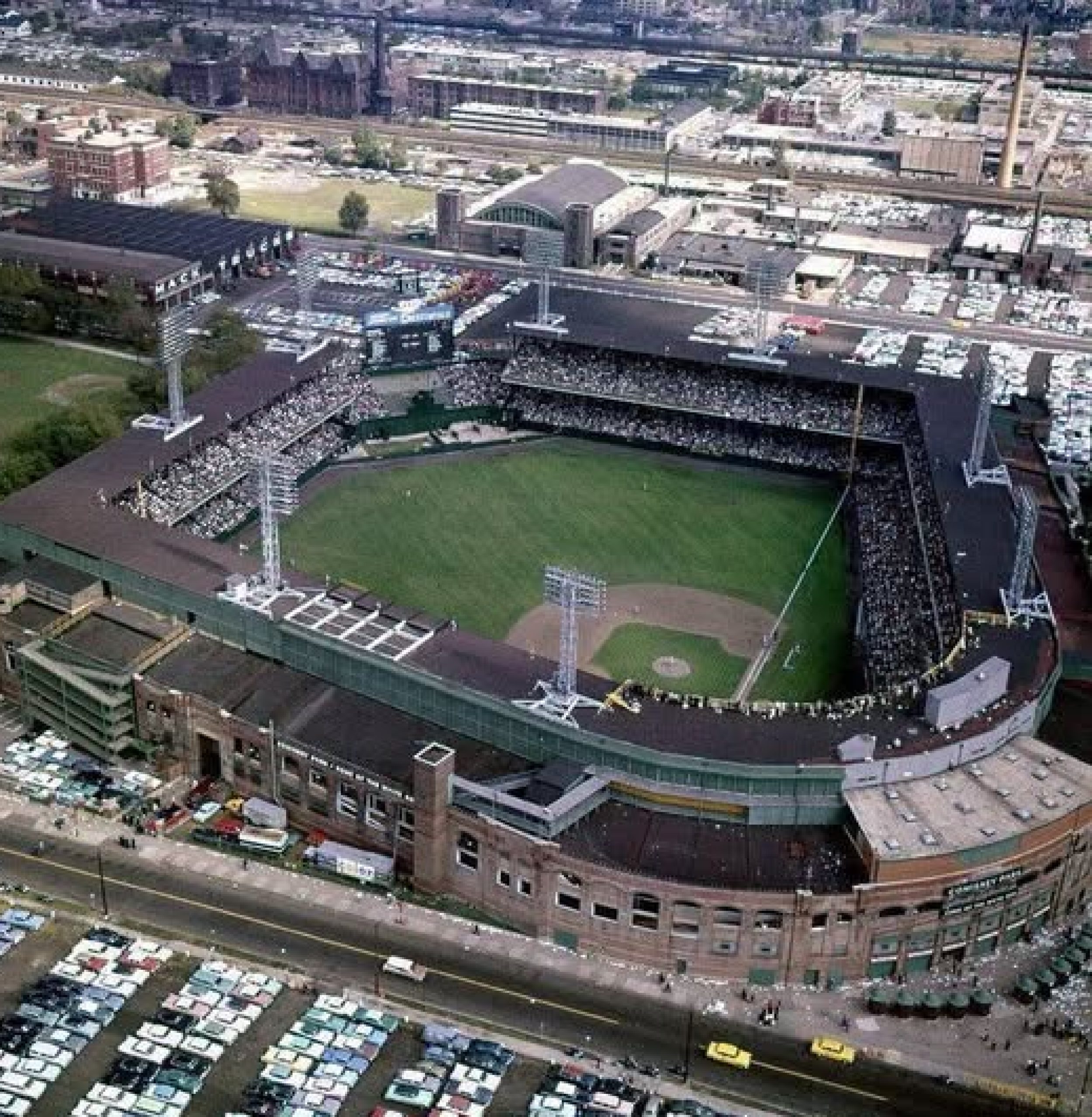
Panoramic Photo Above:
Comiskey Park, Chicago
Baseball History Comes Alive Now Ranked As a Top Five Website by Feedspot Among All Baseball History Websites and Blogs!
(Check out Feedspot's list of the Top 35 Baseball History websites and blogs)
Visit the Baseball History Comes Alive Home Page
Subscribe to Baseball History Comes Alive
Free Bonus for Subscribing:
Gary’s Handy Dandy World Series Reference Guide
Today we welcome back Mike Janacek with an interesting essay about one of – if not the best – outfields in baseball history: the Tigers’ Bobby Veach, Ty Cobb, and Sam Crawford. While much has been written about how great a player Cobb was, Bobby Veach certainly has to rank as one of baseball’s most overlooked and over shadowed stars. I had no idea how good he was until I read Mike’s essay. While his career might fall a bit short of HOF level, I suspect he ranks higher in many categories than others who are in the Hall, and a case can be made that he belongs. If you want to learn about one of baseball’s most overlooked stars, I think you’ll enjoy Mike’s essay. -GL
Baseball’s Dream Outfield!
Bobby Veach, Ty Cobb, Sam Crawford
“With the advent of Veach, the Detroit outfield is one of the most powerful, if not the most powerful, ever assembled on a diamond.”1 –Baseball Magazine, 1915
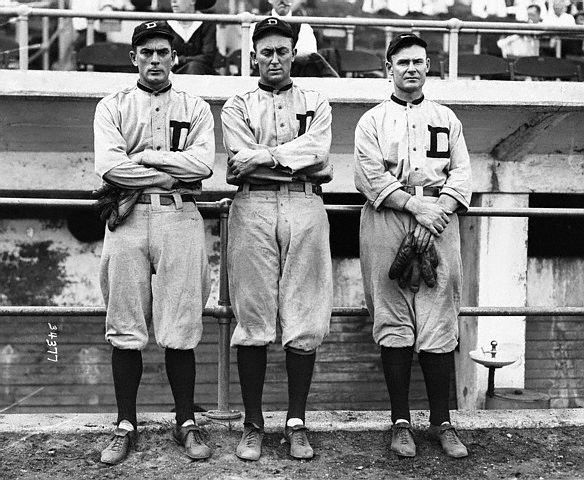
If you were to choose an all-time outfield from the history of Major League Baseball, it would be difficult to surpass the Detroit Tigers lineup of 1915. Bill James, the renowned Baseball Historian, ranked the Tigers’ 1915 outfield of Bobby Veach (left field), Ty Cobb (center field), and Sam Crawford (right field) as the greatest outfield of all time.
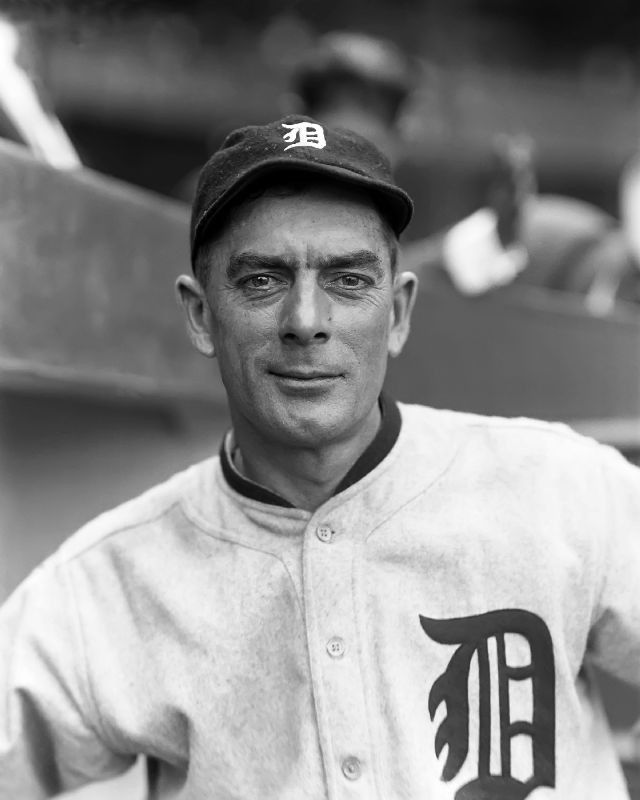
While Cobb’s contributions and feats on the field have become legendary, and Crawford was no stranger to stardom, Bobby Veach remains a mysterious, often forgotten star overshadowed by his higher-profile teammates, both of whom were later inducted into the Baseball Hall of Fame.
The American League batting average was .248 in 1915, while Cobb hit .369 to lead the league while driving in 99 runs, Crawford hit .299 with 112 RBIs, and Veach hit .313 with 112 RBIs, leading the league in doubles with 40. They ranked one, two, and three in RBIs and total bases for the year. While the Tigers won 100 games during the season, they missed the pennant by one game.
Bobby Veach was purchased by Detroit from Indianapolis in 1912 and made his debut on September 6 of that year. He remained the Tigers’ starting left fielder through the 1923 season. Veach was known to hit for both power and average throughout his career. He posted a career batting average of .310 and placed second behind Ty Cobb for the 1919 American League batting title with a .355 mark. Bobby Veach also led the league in runs batted in three times—in 1915, 1917, and 1918—and ranked among the leaders on ten occasions. From 1915 through 1922, no player in baseball recorded more RBIs or extra-base hits than Veach.
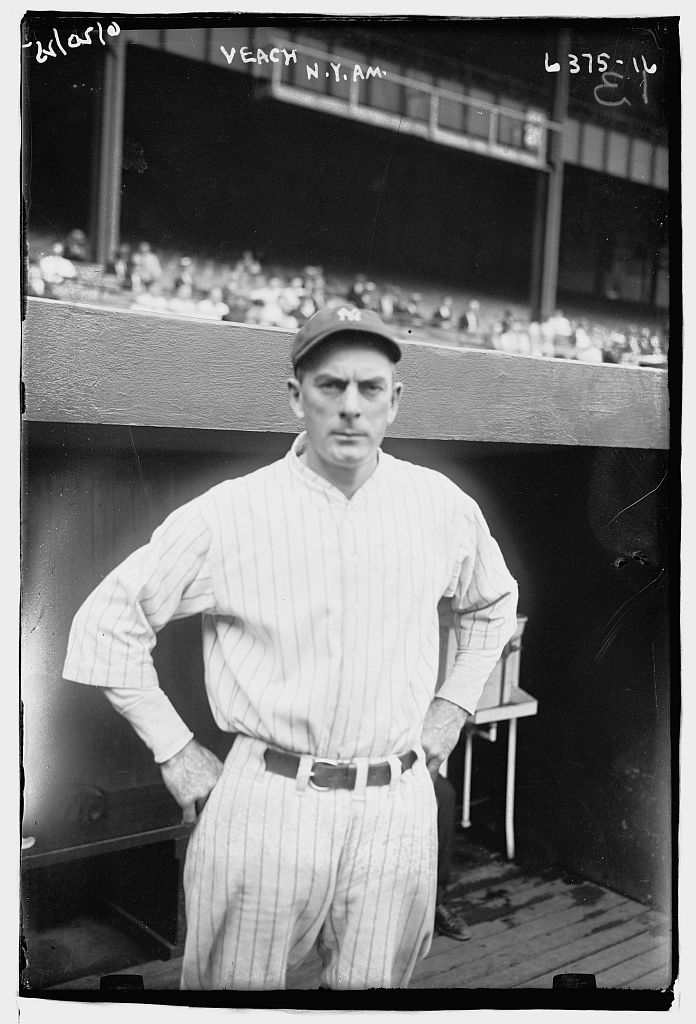
In 1915, Veach became one of the most dominant batters in the American League. His batting average increased over the previous season by 38 points to .313.
His 40 doubles during the year were nine better than the next player, and his 112 RBIs tied him with teammate Crawford. Among the league leaders with 53 extra base hits (2nd), 178 hits (3rd), 247 total bases (3rd), .313 batting average (6th), .390 on-base percentage (6th), .434 slugging percentage (7th), and 68 bases on balls (10th).2 Bobby’s defense also shone as he had 297 putouts, and his fielding percentage of .975 both ranked fifth in the league. Over his career, his double plays by a left fielder of 42 remain an American League record.
Veach’s best year was in 1919, leading the American League in hits (191), doubles (41), and triples (17). Only Babe Ruth and Ty Cobb exceeded him in other offensive categories. His .355 batting average was second to Cobb, and his 65 extra base hits, 101 RBIs, and 279 total bases were second behind Ruth.
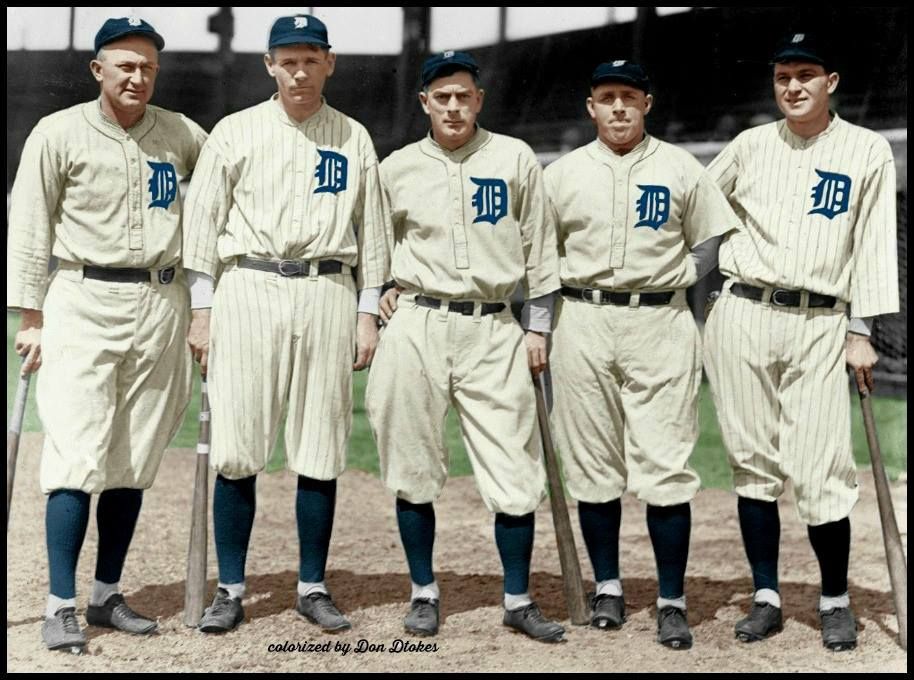
How valuable a player was Bobby Veach? From 1915 to 1922, Veach had 859 RBIs, more than any other player; Cobb had 665, Del Pratt had 641, Hornsby had 638, and Babe Ruth had 623. During this same span, he was the leader in extra base hits with 450, followed by Ruth (445), Speaker (444), Cobb (418), and Hornsby (414).3
As we know, Ty Cobb was one of, if not the greatest, hitters of all time and was also renowned for his defensive skills. In a direct comparison with Cobb, the center fielder with whom Veach played for most of his career, Veach’s impressive range in the outfield shows up very favorably.
In 1914, Veach recorded 282 putouts and 22 assists, while Cobb totaled 177 putouts and eight assists. Although center fielders generally have more opportunities. Veach surpassed him in total chances in seven of the nine seasons they played together in the Detroit Tigers outfield. Veach’s 206 career assists and 2.28 range factor are among the top 10 in Major League history for left fielders. Bobby Veach could not only hit, but he could also field at an elite level.
In early 1924, the Tigers traded Bobby to the Red Sox, where he played one season, then split a season between the Yankees and Senators. After retiring from the majors in 1925, Veach wasn’t quite done with baseball. He spent four years with the Toledo Mud Hens, winning the American Association title in 1927 with a .363 batting average and 145 RBIs. The following season, at the age of 40, Bobby hit .382, winning the American Association batting title. Bobby Veach passed away in Detroit in 1945 after a long illness; he was 57.
Fred Lieb, the Detroit Tigers historian, described Veach as a “happy-go-lucky guy, not too brilliant above the ears”, who “was as friendly as a Newfoundland pup with opponents as well as teammates.”.4
Mike Janacek
Sources:
1 John Ward, “Robert Veach and the $100,000 Outfield: The Sensational Rise of a Young Coal Miner and How He Became a Member of the Greatest Outfield of History,” The Baseball Magazine, 1915.
2 “1915 American League Batting Leaders.” Baseball-Reference.
3“For combined seasons, from 1915 to 1922, in the regular season, sorted by descending Extra Base Hits”. Stathead. Retrieved July 21, 2025.
4 Al Stump, Cobb: The Life and Times of the Meanest Man Who Ever Played Baseball (1994), 327–328.
Subscribe to Baseball History Comes Alive. FREE BONUS for subscribing: Gary’s Handy Dandy World Series Reference Guide. https://wp.me/P7a04E-2he
Visit the Baseball History Comes Alive Home Page
https://www.facebook.com/Don-Stokes-Old-Time-Baseball-Colorizations-923346241033508




Wasn’t Bob Fothergill’s nickname ‘Fatty?’ He doesn’t all that chunky to me.
Yeah his nickname was “Fatty.” There’s plenty of pics of him round where you can see why he had that nickname!