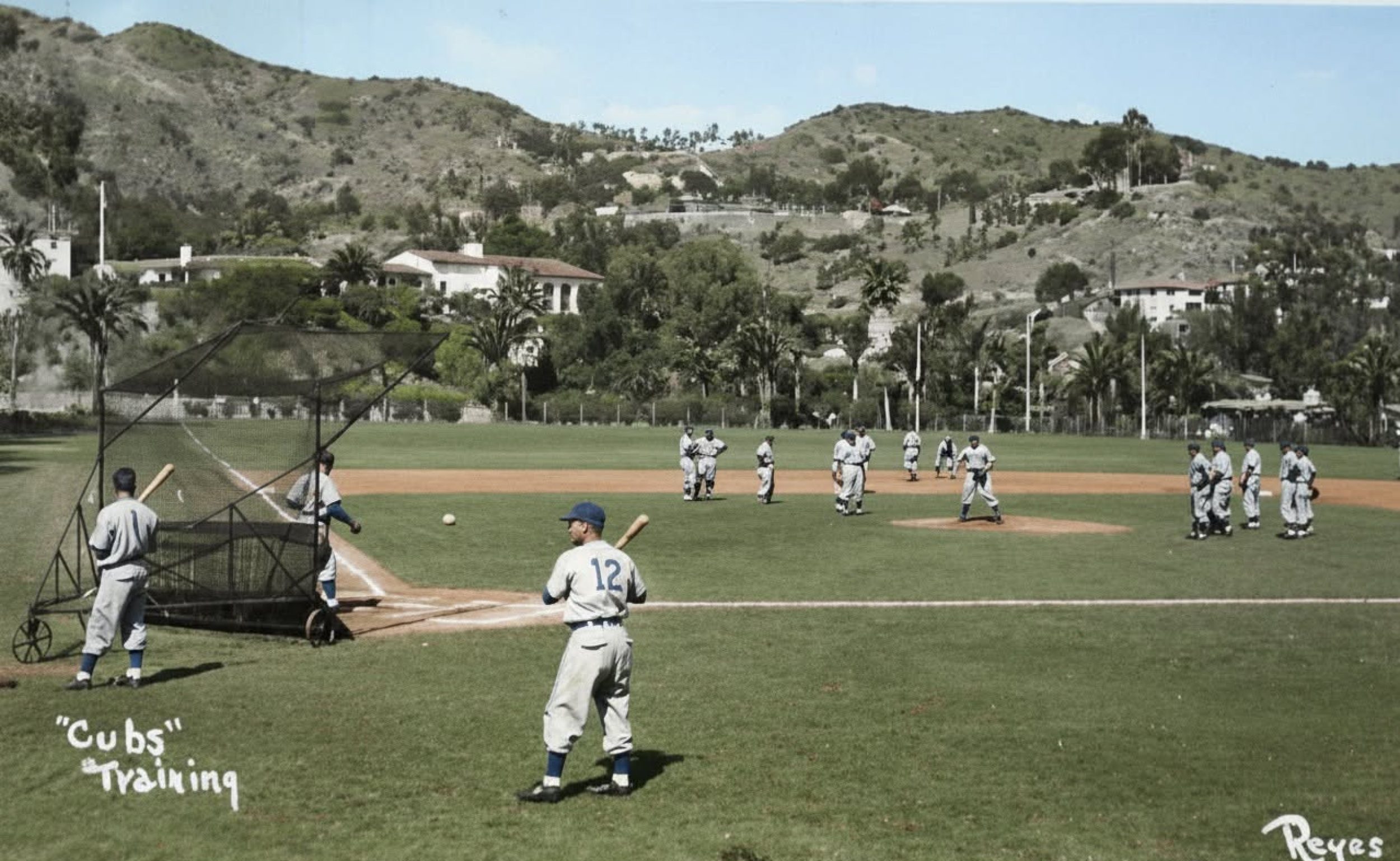
Panoramic Photo Above:
Cubs Spring Training on Catalina Island
Baseball History Comes Alive Now Ranked As a Top Five Website by Feedspot Among All Baseball History Websites and Blogs!

(Check out Feedspot's list of the Top 35 Baseball History websites and blogs)
Guest submissions from our readers always welcome click for details
Visit the Baseball History Comes Alive Home Page
Subscribe to Baseball History Comes Alive
Free Bonus for Subscribing:
Gary’s Handy Dandy World Series Reference Guide
Dummy Hoy Photo Gallery
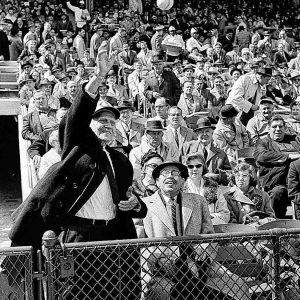
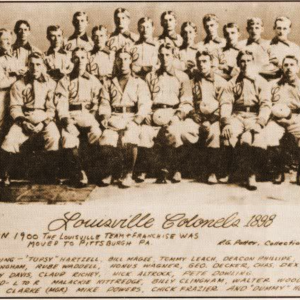
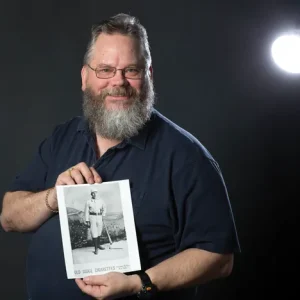
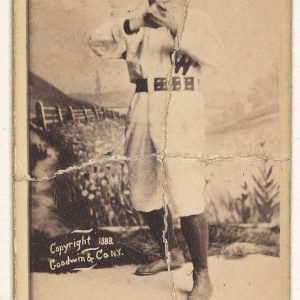
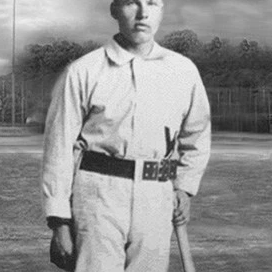
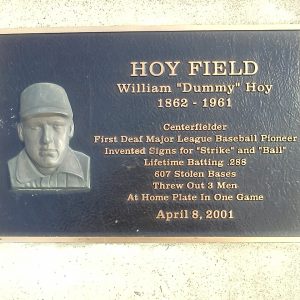
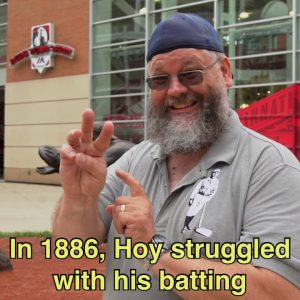
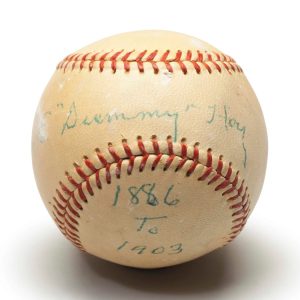
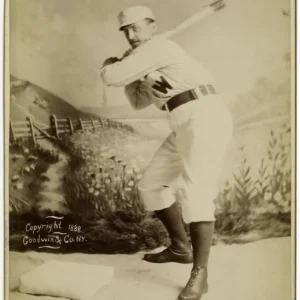
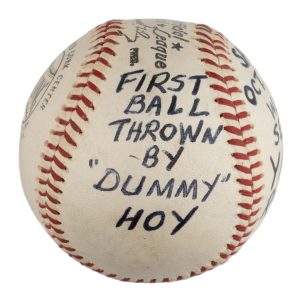
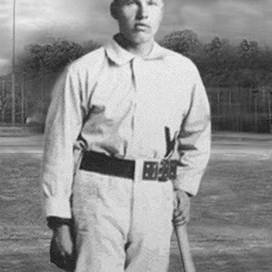

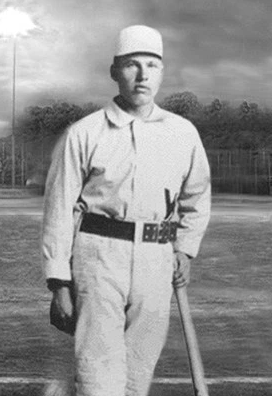
With September being Deaf Awareness Month and September 23rd being International Day of Sign, we’re happy to feature a guest essay today from Steve Sandy, who is himself a member of the Deaf community. Steve is a recognized authority on William “Dummy” Hoy, a deaf major leaguer who played 14 seasons in the big show (1888-1902) for six teams. In addition to having an outstanding career (.288. average, 2048 hits, 40 home runs, 725 RBIs, .596 stolen bases, 398 on-base percentage), he is credited with inspiring the visual hand signals umpires use today, a part of the game we take for granted. I think you’ll enjoy Steve’s essay, and be sure to check out Sign for Hoy, a campaign bringing renewed attention to Deaf baseball pioneer William “Dummy” Hoy -GL
Every Fan Knows the Umpires’ Hand Signals –
But Almost Nobody Knows Dummy Hoy
I was born in Honolulu in 1961, one month before William “Dummy” Hoy passed away in Cincinnati. We never crossed paths in this world. But in 1989, I went looking for him, and I haven’t stopped since.
I’m Deaf myself, and somewhere along the way I heard the name Dummy Hoy the way a lot of Deaf kids do, as a rumor, half legend, half footnote. A Deaf man who played major league baseball in the 1880s and 1890s? I had to know more. So I started calling people. A Deaf club in Cincinnati connected me to Hoy’s own relative, Judson Hoy, who pointed me toward the Society for American Baseball Research. That was the beginning of a research trail that’s taken me to Washington, D.C., Hartford, Delavan, Los Angeles, New Orleans, Pasadena, and more times than I can count, back to Columbus, Ohio, which turned out to be the mother lode. Thirty-six years later, my basement is basically a Dummy Hoy museum, and I still find something new every time I dig.
So let me tell you who this man actually was.
A ballplayer nobody wanted to let go of
Hoy was born hearing and lost his hearing to spinal meningitis as a small child, back when that disease was leaving a trail of deaf, blind, and disabled kids across the country. He grew up on a farm in Ohio, went to the Ohio State School for the Deaf, and by all accounts was a brilliant student. The valedictorian of his class, with English so sharp people described it as Shakespearean. He trained as a shoe cobbler. But baseball got its hooks in him at school, and once it did, it never let go.
He stood 5-foot-4, and I’ve seen writers inflate that to 5-foot-6 over the years, which always makes me smile — the man was the smallest guy on the field and still ran the outfield like he owned it. He worked his way up through semi-pro ball in Ohio, and when a scout finally saw him play, it set off a bidding war between Milwaukee and Oshkosh that ended with Hoy scribbling a note, standing up at the table, and sliding it down to the Milwaukee manager: “I wouldn’t play for your team for a million.” That’s Dummy Hoy in one sentence, quiet, sharp, and not the least bit intimidated.
He made the majors in 1888 with the Washington Senators, and over an 18-year career he played for Washington, Buffalo, St. Louis, Cincinnati, Louisville, Chicago, San Francisco, and Los Angeles. As a rookie he stole 88 bases, which stood as a record. He hit .365 one season in the minors that got him noticed by the big leagues in the first place, and across his career he rarely dipped below .250 for long. And then there’s the play nobody has ever matched: in a single game in 1889, throwing bare-handed from center field, he threw out three baserunners at the plate. No relay. Just Hoy’s arm and a catcher named Connie Mack waiting for the ball.
The signals
Here’s the part of the story that means the most to me, and the part I think every fan should know, whether or not they know Hoy’s name. Because Hoy couldn’t hear the umpire call balls and strikes, he needed a way to know the count from the field and at the plate. So the umpires started raising a hand for a strike, and the story handed down through generations of Deaf baseball fans is that this is where the hand signals we still see on every diamond in America got their start. Whether every umpire in that era adopted it because of Hoy specifically, historians will argue about the details forever. But the Deaf community has carried this story for well over a century, and I believe it, because it fits everything else I know about how Hoy moved through a hearing world, not by asking for less, but by figuring out how to get exactly what he needed and letting everyone else adjust.
The man off the field
Hoy could actually speak, up to about 200 words, and the first word out of his mouth before signing any contract was always “salary.” His wife, Anna, was said to be one of the best lip-readers in the country — good enough that Alexander Graham Bell himself was impressed by her, which is a strange little irony given Bell’s role in pushing Deaf teachers out of schools like the one Hoy attended.
After baseball, Hoy ran a farm outside Cincinnati. Twenty-three and a half acres, hundreds of chickens, milk and vegetables he hauled to the local grocery himself. He hired homeless men to work the farm, got them back on their feet, and hired more. During World War I he went to Akron to manage part of the blimp manufacturing effort and hired heavily from the local Deaf community, to the point that Akron’s Deaf population grew because of it. He and Anna had six children, all with names starting with C, and buried two of them along the way, including one lost to the 1918 flu. He lived to be 99, cremated, his ashes scattered at Lytle Park in Cincinnati, the city where I first started this whole search.
Why he still matters
I’ve spent thirty-six years on this because Dummy Hoy is proof of something the Deaf community has had to prove over and over: that Deaf people don’t need less opportunity, they need the world to make room for how they communicate. Hoy didn’t wait for baseball to accommodate him. He and the umpires built a system together, and it’s still on the field today, whether the crowd knows his name or not.
That’s exactly why I think he belongs in the National Baseball Hall of Fame. His numbers hold up against contemporaries who are already in. His influence on the game’s visual language is still in use in every ballpark in America. And his life is the kind of story baseball claims to love telling — the outsider who outworked and outsmarted everybody who doubted him. A Ph.D. once told me I’m the foremost authority on Dummy Hoy, and I’ve carried that seriously for a long time. But the truth is I don’t want to be the only one carrying it. I want every fan who sees an umpire raise a fist for strike three to know whose story is baked into that gesture.
Steve Sandy
Steve Sandy has spent a lifetime preserving the definitive physical record of Dummy Hoy’s life and career. His private collection stands as the most comprehensive archive of Hoy memorabilia in existence, and has become the evidentiary backbone of the SignForHoy campaign, a campaign to bring the Deaf baseball pioneer’s story to new audiences and secure his induction into the National Baseball Hall of Fame. Sign the petition to help Hoy get the recognition he deserves. SignForHoy.com
Sources
– Reisler, Jim. The Talented Misters Hoy and Taylor: Two Deaf Players, the Great Game of Baseball, and the Barriers They Broke Together.
– Society for American Baseball Research (SABR), Biography Project entry on William “Dummy” Hoy.
– Author’s personal research archive, gathered since 1989, including correspondence with Judson Hoy and materials collected in Washington, D.C., Hartford, Delavan, Los Angeles, New Orleans, St. Louis, New York, San Francisco, Pasadena, Cincinnati, and Columbus.
Subscribe to Baseball History Comes Alive. FREE BONUS for subscribing: Gary’s Handy Dandy World Series Reference Guide. https://wp.me/P7a04E-2he
Visit the Baseball History Comes Alive Home Page