
Panoramic Photo Above:
Baseball History Comes Alive Now Ranked As a Top Five Website by Feedspot Among All Baseball History Websites and Blogs!

(Check out Feedspot's list of the Top 35 Baseball History websites and blogs)
Visit the Baseball History Comes Alive Home Page
Subscribe to Baseball History Comes Alive
Free Bonus for Subscribing:
Gary’s Handy Dandy World Series Reference Guide
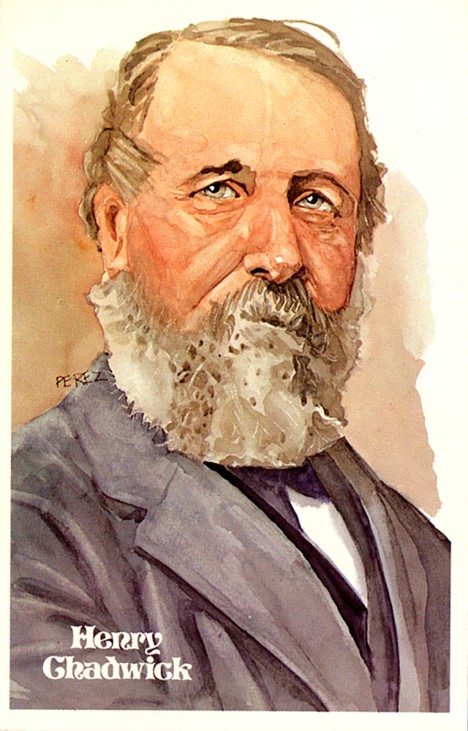
Today, Vince Jankoski returns with an interesting “deep dive” into the origins and evolution of the baseball box score. Starting with Henry Chadwick, who first developed the box score in the 1880s, we learn how it has adapted to all the changes that have taken place over the years, and how much more efficient it is than box scores from other sports. I think you’ll find Vince’s essay interesting. In the featured photo, we see Henry Chadwick, the developer of the first box score. -GL
A Deep Dive Into the Old Reliable Baseball Box Score!
Baseball adopts inventions and puts them to good use. Concrete and steel construction, parking garages, sprinkler systems, and overpriced beer existed long before baseball made them part of the viewing experience. On the other hand, some inventions are particular to baseball and would not have been created but for the game: the fielder’s glove, the resin bag, the batting cage.
There is no greater invention generated by baseball than the humble box score. The box score is not only baseball’s greatest invention. It ranks as one of the greatest information inventions of all time. If you find that hard to believe, consider what follows.
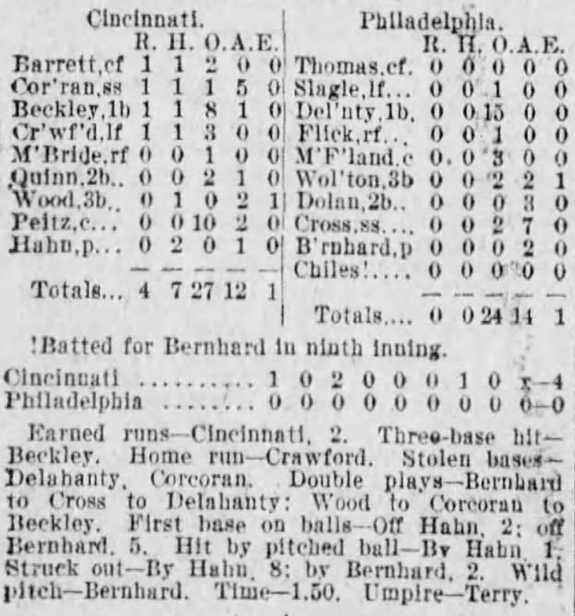
As an initial matter, consider how one measures the greatness of an invention. A great invention must have, above all, utility. It must serve a useful purpose. The invention must also be efficient, that is, it must do its job better than the alternatives or what came before it. An invention must be durable such that it lasts a long time. In order to be durable, an invention must have adaptability. An invention must have convenience. Then, too, an informative invention, like the box score, must have objectivity. Opinions, however disguised, have no place. Finally, imitation evidences a great invention. The box score has all of these.
There is no question but that the box score has utility. The reader uses the box score to discern the events of a game he or she was unable to view in person or on television. Without the box score, the baseball fan, unable to spend three hours watching the previous day’s game, would be ignorant about the contest.
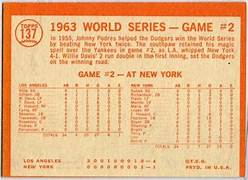
The box score is certainly efficient. Four to five inches long and the width of a standard-sized newspaper column, the box score condenses three hours of vigorous physical activity into six or seven square inches of print. In less than a minute, the reader can learn all of the information he or she wishes to know about his team’s latest effort. In that small space, the fan will learn the names of each of the game’s participants, how many times each batted, the number of times each scored, the hits, runs, RBIs, strikeouts, and walks of each player. Scrolling down the page, the reader sees the line score and thus is able to learn the game’s turning points. Below the line score, the reader is informed of the players who committed errors, the number of runners left on base, the number of doubles and triples attained by each player and that player’s season totals, which players hit home runs (with the player’s season totals) and the pitcher who surrendered those gopher balls, and the players that stole bases, again with season totals. And that’s even before the reader gets to the pitchers. The pitchers’ totals inform the reader of how long the pitcher worked, his effectiveness, the winning, losing, and saving pitchers, wild pitches and passed balls. Further down, the reader, if he is interested, learns the time the game took to play and the attendance in relation to the park’s capacity. All of this information is imparted in, maybe, less than a minute’s worth of reading time. By extension, the reader can learn the gist of the entire major league schedule for the previous day by scanning all of the printed box scores in a relatively short period of time.
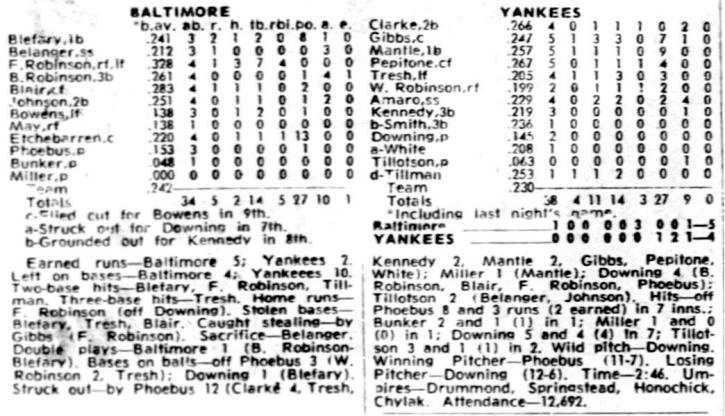
Convenience is also part of the baseball box score. The box score can be easily read by a busy commuter on his or her bus or train ride, making good use of otherwise dead time. But for the box score, a fan unable to view a game would need to read a sportswriter’s long and possibly biased account of the game, wait for the sports segment on television or radio, or go without any knowledge whatsoever of the previous day’s game.
Due to its adaptability, the box score has also been durable. The Baseball Hall of Fame credits Henry Chadwick with creating the box score in 1858. Although it has existed continuously throughout baseball history, it has changed to fit the times. The original box scores included times at bat, runs scored, and times reached base, but they also included some fielding statistics like putouts and assists absent from present-day box scores. When runs batted in became a recognized statistic in the early days of the Twentieth Century, that metric was added to the box score. The same is true for earned run averages. Later improvements included players’ season totals, the game’s attendance figures, the number of inherited runners allowed to score by a relief pitcher, and the number of pitches thrown by individual hurlers. The most recent modification is the addition of ABS challenges and their results. Unfortunately, there have also been deletions, the most troubling being the omission of the names of the umpires who called the game. Through it all, the box score has adapted to changes in the game.
The box score is certainly objective. With the exception of the discretion that goes along with the official scorer ruling a batted ball a hit or an error, the box score objectively and correctly recounts what occurred in the game. Unlike much of the rest of the media world, it is completely unbiased. If Ty Cobb got three hits in a particular game, then Ty Cobb got three hits in that game. Regardless of what the reader thinks of Ty Cobb, the man got three hits.
As proof of its success, the baseball box score has been imitated, albeit imperfectly, by other sports. Football box scores are longer and, thus, less efficient. Basketball box scores do not capture the ebb and flow of a game in that the line portion of the box score is broken down into only four quarters. The reader is left to wonder whether there was a scoring run in the middle of a quarter that determined the outcome of the game. By contrast, if the baseball score shows seven runs in an inning in an 8-5 game, then surely the seven-run frame was determinative. Hockey box scores are even less informative, being limited to little more than the scoring aspect of the game. In each of these other sports, unlike baseball, the box score is no effective substitute for viewing the game itself. The baseball box score stands above all others.
The baseball box score is truly a superior invention. When it comes to information revolutions, I put the baseball box score right up there with the printing press and the internet – at least for baseball fans.
Vince Jankoski
Photo Credits: All found on Google search
Subscribe to Baseball History Comes Alive. FREE BONUS for subscribing: Gary’s Handy Dandy World Series Reference Guide. https://wp.me/P7a04E-2he
Visit the Baseball History Comes Alive Home Page