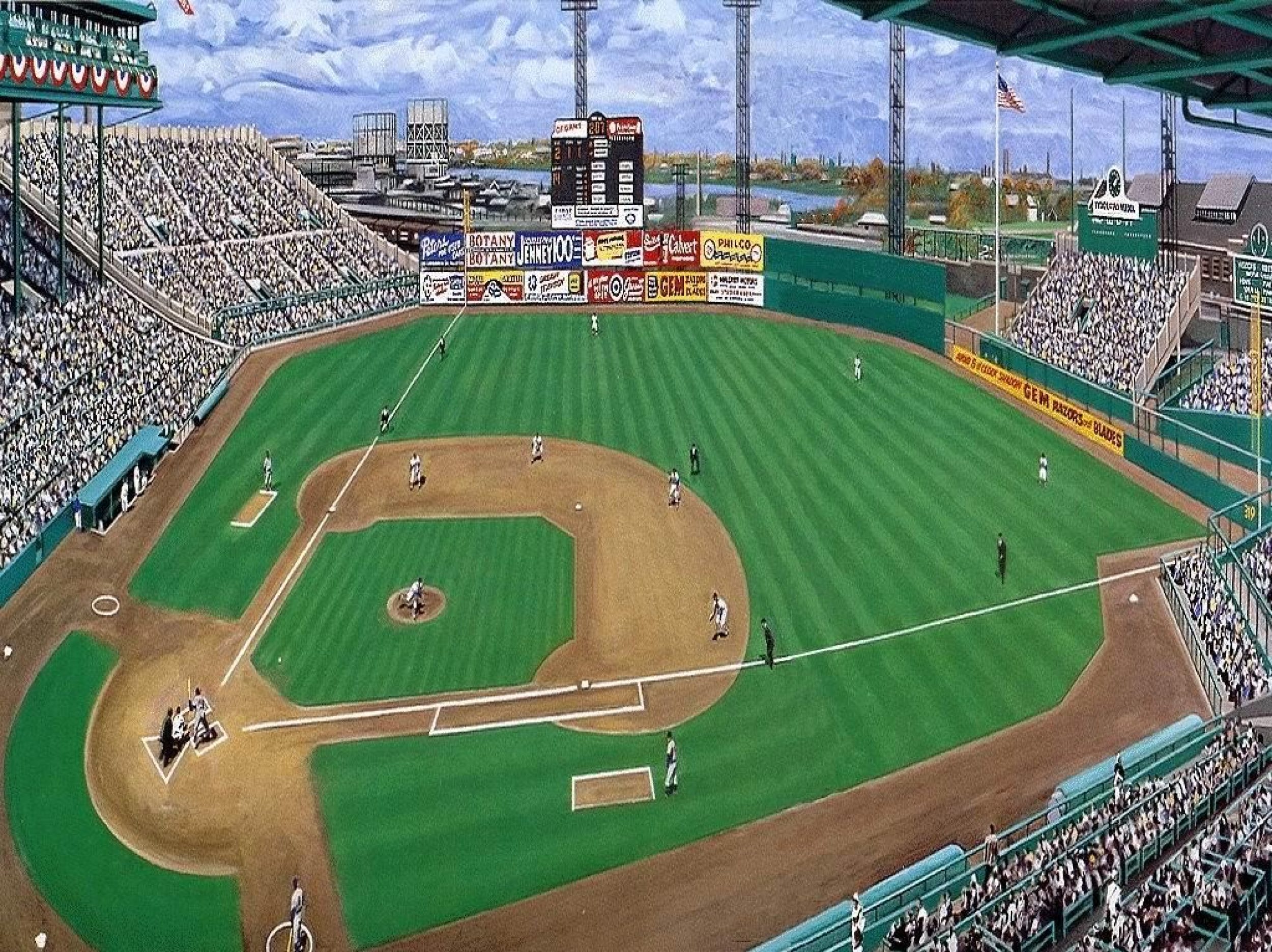
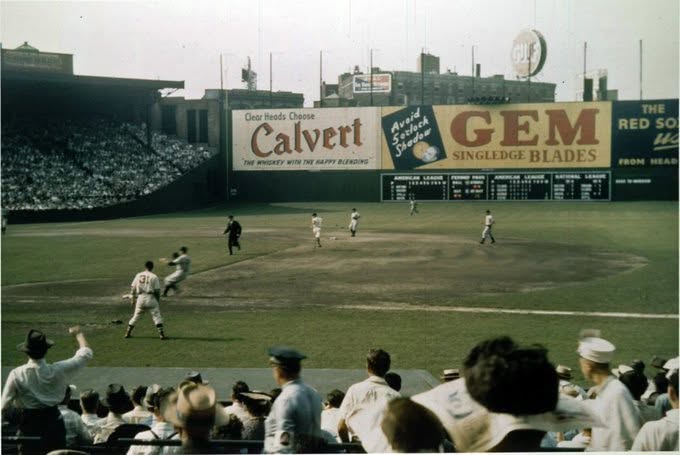
Panoramic Photo Above:
Braves Field during 1948 World Series
Baseball History Comes Alive Now Ranked As a Top Five Website by Feedspot Among All Baseball History Websites and Blogs!
(Check out Feedspot's list of the Top 35 Baseball History websites and blogs)
Visit the Baseball History Comes Alive Home Page
Subscribe to Baseball History Comes Alive
Free Bonus for Subscribing:
Gary’s Handy Dandy World Series Reference Guide
Today we welcome back Ron Christensen with a detailed look at Fenway Park. Ron highlights the history of Fenway and also some of its “quirkiness” that makes it unique among major league ballparks. Even though Ron is a lifelong Yankee fan, he still finds Fenway fascinating. I found his discussion of the Pesky Pole to be very interesting, and I think you will too. -GL
Fenway Park and the Pesky Pole!
If you’ve never been to Fenway Park to see a ballgame, add it to your bucket list. This iconic, feature-filled ballpark, unique in character and steeped in history, is a must-see venue for every baseball fan. Located in Boston’s Fenway-Kenmore neighborhood, Fenway Park is listed on the National Register of Historic Places.
Fenway is the oldest, continually operated major-league ballpark still in use today, opening its doors for its first-ever game on April 20, 1912, a game that saw the host Boston Red Sox narrowly defeat the New York Highlanders (their future hated rival Yankees) 7-6 in 11 innings. Sadly, this inaugural game was overshadowed in the papers by the continued coverage of the sinking of the Titanic only five days earlier.
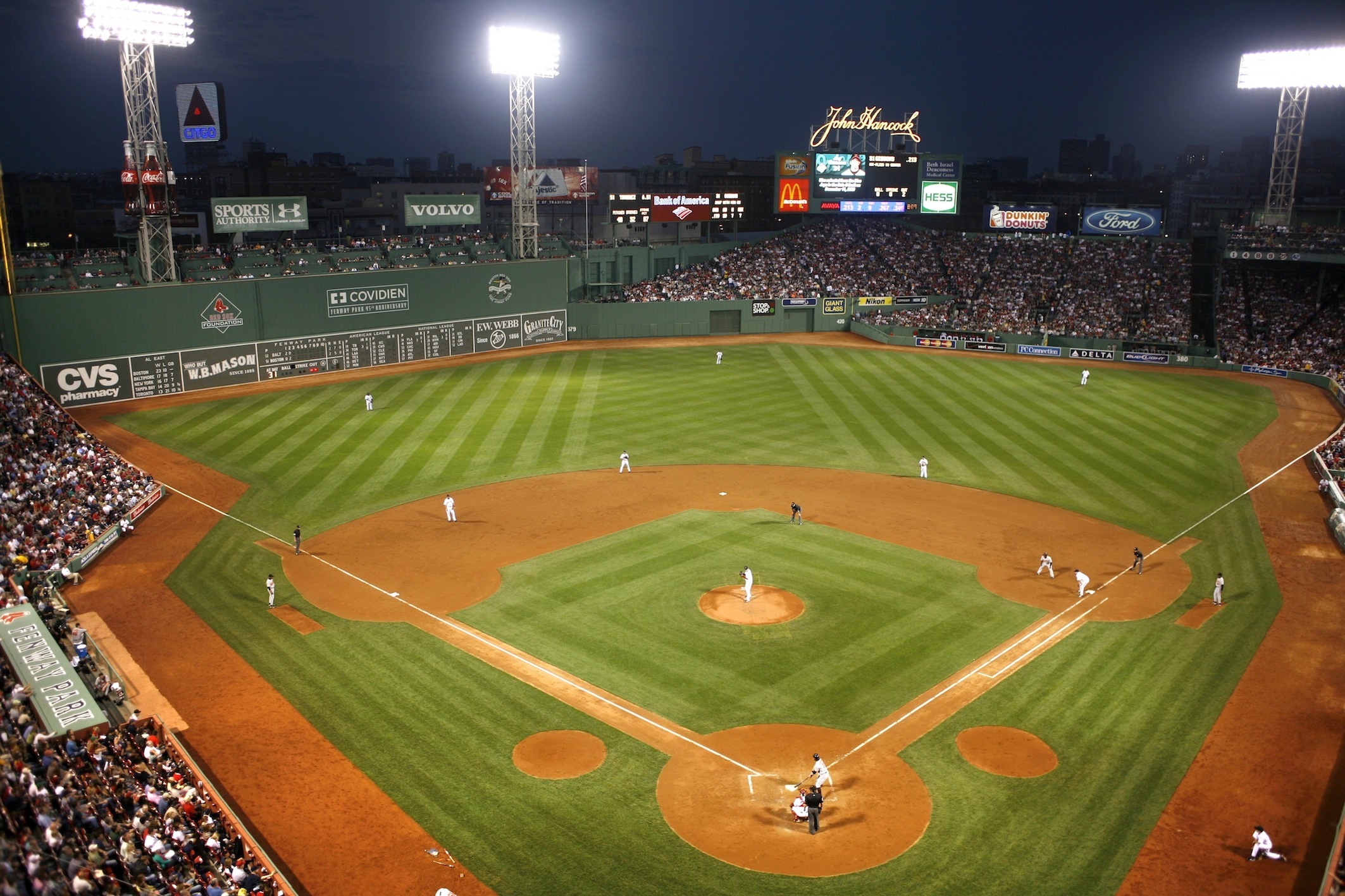
Situated on an asymmetrical city block, the bounded limits of the ballpark required an
improvised design that resulted in irregular field dimensions, aptly described in the following passage by the author, John Updike: “Fenway Park in Boston is a lyric little bandbox of a ballpark . . . a compromise between man’s Euclidean determinations and nature’s beguiling irregularities.”
Fenway’s irregular dimensions are just one of the many quirky features that contribute to its charm. There is, of course, the Green Monster (Green ‘Monstah’), the 37’ 2” tall behemoth of a wall that extends 231 feet across left field. Constructed in 1934 when much of Fenway was rebuilt after damage from a fire, you might think the idea behind the Monster was to enable right-handed batters to bounce doubles off it all game long. But the Green Monster – not painted green until 1947 – traces its lineage to a 25-foot-high barrier wall original to the Park that prevented spectators from viewing games from the homes that lined Landsdowne Street behind left field.
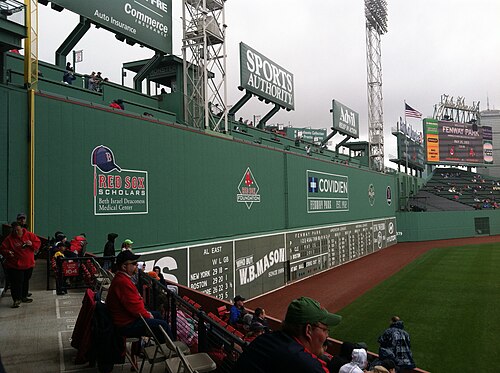
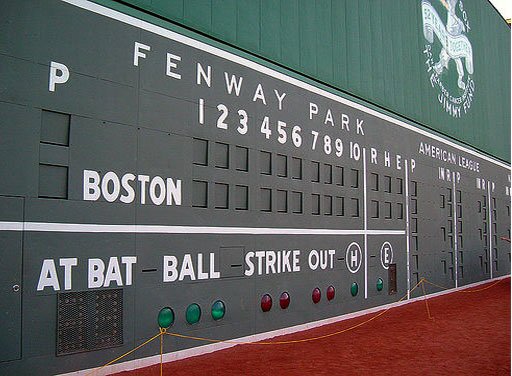
Inside the lower half of the Green Monster is a manually operated scoreboard replete with 127 slots adjusted by hand by three individuals, one of whom updates the game score while the other two update scores from around the league. The space boasts the signatures of players who, through the years, have ventured inside to autograph the wall’s interior surfaces. It is also home to a hidden rat population, though it’s never been verified that the rats have taken shifts to operate the scoreboard on game days.
Fenway’s quirky outfield dimensions are on full display in The Triangle, an area where the wall in deep right-center veers even deeper at a sharp angle beyond the Sox bullpen, then veers back at an equally sharp angle crossing centerfield. The configuration resembles a sort of triangle, which at its furthest point measures 420’ from home plate. Complicating the angles is the disparity in wall height, from 3’ at the bullpen to 9’ at its apex, and 17’ across centerfield. It’s a challenge for even the most seasoned outfielder, as balls landing here often resemble pinballs bouncing unpredictably off rubber bumpers.
Then there’s the smaller triangle – the bright red one affixed to the giant CITGO sign looming large over Kenmore Square since 1940. Though not actually a part of the ballpark, this landmark sign has become so closely associated with Fenway that it’s considered one of its most identifiable features.
And let’s not forget the lone red seat, the only one among a sea of green. Located high up in the right field bleachers, it signifies the longest home run ever hit in Fenway, a blast by Ted Williams measuring 502’ that he hit on June 9, 1946. The ball landed on the head of Joseph Boucher, who was sleeping in the seat at the time. Uninjured, Boucher quipped, “How far away does one have to sit to be safe in this park?” and complained that since the ball bounced off his head into the seats behind him, he didn’t even get to keep it.
Last but not least is The Pesky Pole, Fenway’s famous right field foul pole. This is not to be
confused with The Fisk Pole, a/k/a Pudge’s Pole, the name given to Fenway’s left field foul pole. That one is named for Carlton Fisk and his heroic game-winning home run in the twelth inning of Game Six of the 1975 World Series, with Fisk jumping up and down and waving his arms to his right, willing the ball to remain fair, which it did, bouncing off the foul pole and sending the Series to a deciding seventh game. But why did the cameraman remain focused on Fisk rather than follow the flight of the ball as the cameramen were instructed to do? Because the cameraman was distracted by a rather large rat scurrying uncomfortably close to him, forcing him to keep the camera focused on Fisk, thereby resulting in the unintentional capture of one of baseball’s most enduring highlights. Sometimes truth is stranger than fiction.
Back to The Pesky Pole. This one is named for Johnny Pesky, a revered Red Sox player, coach, and manager who played for ten seasons, 1942 to 1954, missing two seasons for military service. Located a mere 302’ down the right field line, the Pesky Pole marks the shortest outfield distance of any major league ballpark. But don’t be fooled, this is no easy home run, as the fence from this point slants sharply outward to a distance of 380’.
One might assume Pesky, a left-handed batter, was a home-run hitter with a stroke that bounced balls off or hooked them around the foul pole. Hardly. In his ten seasons, 1270 games and 4745 at-bats, Pesky hit only 17 home runs, and only six of those were hit at Fenway.
Enter Mel Parnell, a pitcher and teammate of Pesky’s who coined the term the Pesky Pole after Pesky hit a home run around it to win a game Parnell had pitched in 1948. But records show that Pesky hit only one home run while Parnell was pitching, a two-run shot against Detroit in 1950 in a game won by the Tigers in 14 innings.
In 1965, Parnell became a Red Sox broadcaster and often referred to the pole as the Pesky Pole. From Parnell’s lips to Baseball’s ears, the league’s most famous foul pole got its name. The Red Sox made this official on September 27, 2006, Pesky’s 87th birthday, with a ceremony and commemorative plaque dedicating the pole in Pesky’s honor. The plaque recognizes the pole as “Pesky’s Pole”.
So make your way to Fenway Park, sign your name to Pesky’s Pole (yes, you can), and enjoy a ballgame in one of baseball’s most iconic and historic settings. While there, be sure to eat a famously delicious Fenway Frank (the secret is the two-step cooking method of boiling then grilling), and in the middle of the eighth inning sing along to Neil Diamond’s Sweet Caroline (oh-oh-oh), a Fenway tradition since 1997.
You don’t have to root for the Sox to appreciate the ballpark and all it has to offer. I’m a lifelong Yankees fan myself. But don’t root too loudly for the other team, because at Fenway you just might end up with a beer splashed on your head.
Ron Christensen
REFERENCES:
1. Wikipedia – Fenway Park
2. The Unique History of Pesky’s Pole at Fenway, by Ian Browne (2023)
3. The Physics of Pesky’s Pole, by David Kagan (2014)
4. Ode to a Foul Pole, by Matthew Sieger (2025)
5. Fenway Park Architecture, by Gavin Paisley for Chisel & Mouse (2026)
6. Boston’s Fenway Park Uses A Clever Two-Step Process To Keep Hot Dogs Juicy, by Maria
Scinto (2026)
7. Center Field Triangle, by FenwayFanatics.com
8. Baseball Reference – Johnny Pesky
9. Hub Fans Bid Kid Adieu, by John Updike, New Yorker Magazine (1960)
Subscribe to Baseball History Comes Alive. FREE BONUS for subscribing: Gary’s Handy Dandy World Series Reference Guide. https://wp.me/P7a04E-2he

















As a Fenway attendee numerous times per season and over 525 lifetime, I have found that between the marketing of the team and the team’s abysmal play at home over the last few years, the electric atmosphere is, for the most part, missing. It is common now to see hordes of visiting team fans congregated together in sections (via the team’s travel agency) or scattered in noticeable numbers throughout the park and audible when their team is rallying.
The Sox’ most recent homestand that included part of their 15 game winning streak
seemed to jumpstart the passion, at least, for the last two weeks.
That being said, Fenway along with Wrigley have been the too ballparks that still have the most memories of major league history simply because of the many games and players that have passed through them for over 110 years.
Thanks, Paul. Good insight. I do think Fenway is a great place to see a game, and agree with you that the other park teeming with history is Wrigley Field. I’ve never attended a game at Wrigley, but hope one day to do so. I appreciate your comment.
Hi!
Loved the articles on Warren Spahn and on the Pesky Pole.
I went to a game at Fenway Park in 1976 . Although Ted Williams had not played there for many years, you could still hear people talking about him. His presence was still there.
At Fenway, I felt so clase to the field. It was raining, and Rick Wise was pitching. It seemed that I could see the beads of rain on his glasses– that’s how close it seemed.
For six springs, from 1982 through 1987, I worked in the K.C. Royals Spring Training Camp in Ft. Myers, Florida. The Red Sox were in town, and a coach was hitting high fungos to the outfielders.
He looked quite a bit older than everyone else on the field, but could really belt out those fungos. I introduced myself, and he told me his name: “Johnny Pesky.”
I was speechless.
Thanks Joe…some great remembrances for sure!
Thanks, Joe. Glad you enjoyed the article. Great story of meeting Johnny Pesky. A special experience for sure, especially meeting him on the field with a bat in his hands.
Thanks for the article
I made my pilgrimage to Fenway on a cold mid May 2015 night to see the Red Sox host the Oakland As, but mainly to see the Green Monster, the left field foul ball and recall Pudge’s home run at the bottom of the 12th game in game 6 of the 1975 world series that I stayed up late to watch. Also made me think about the Red Sox greats Ted Williams and Yaz.
While I am not a sox fan, I am a baseball fan and visiting Fenway is an experience to remember!
Thanks for checking in Benny…Some great memories right there. Please stay in touch!